
Breast Biopsy
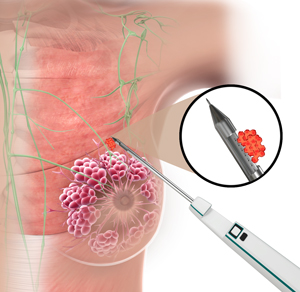
Once a breast lump or breast abnormality has been detected, your doctor may want to conduct a breast biopsy. This procedure involves taking sample tissue from the suspicious area to determine whether the breast lump is cancerous.
While the thought of having a breast biopsy might be frightening, the results can provide reassuring peace of mind. Remember, the vast majority of breast biopsies do not turn out to be breast cancer. And a biopsy is currently the only way to achieve an accurate breast cancer diagnosis.
There are various breast biopsy options to consider. The choices range from an open surgical procedure to new minimally invasive techniques. Be sure to understand your biopsy options and talk with your doctor to determine the procedure that is best for you.
There are two methods for producing images in minimally invasive breast biopsies:
Stereotactic & Ultrasound guided
Stereotactic biopsy
Stereotactic [STARE-ee-o-TAK-tik] biopsies use mammography (x-rays) to locate breast abnormalities, while ultrasound biopsies use high-frequency sound waves to create breast tissue images.
In a minimally invasive breast biopsy using stereotactic imaging, a patient lies face down on a special table with her breast protruding through a hole in the table’s surface. The breast is lightly compressed to immobilize it throughout the biopsy procedure. The table is connected to a computer that produces detailed x-ray images of the abnormality to be biopsied. Using these images, the doctor guides a special sampling device (for example, biopsy probe) to collect tissue specimens.
Ultrasound guided biopsy
Minimally invasive breast biopsies using ultrasound imaging are performed on patients in an upright or reclined position. Using a hand-held transducer, a doctor will move the device back and forth across the breast to generate clear images of the abnormal breast tissue. While viewing the images on a computer monitor, the doctor will guide a small probe into the breast to retrieve sample tissue specimens.
Core Needle Breast Biopsy
In a core needle biopsy, the physician makes a small skin incision through which a needle is inserted into the lesion to obtain sample tissue. The hollow spring-loaded device is “fired” repeatedly into the abnormality to collect a sufficient amount of breast tissue for analysis. Usually, 4 to 6 samples are taken (4 to 6 insertions). This biopsy procedure is performed in an outpatient setting or doctor’s office without general anesthesia or stitches.
Fine Needle Aspiration Breast Biopsy
Fine Needle Aspiration (FNA) is a biopsy procedure that uses a thin needle on a syringe to draw fluid and/or cellular material from a breast abnormality. Thus, Fine Needle Aspiration provides information about cellular material, whereas the other tissue biopsy procedures allow tissue within the abnormality to be compared to surrounding tissue for a more accurate diagnosis. Fine Needle Aspiration is most often used to aspirate, or drain fluid, from benign (non-cancerous) fluid-filled cysts. However, the extracted fluid can be examined by a pathologist to confirm whether the abnormality is benign or requires further testing.
Fine Needle Aspiration biopsy procedures are generally performed by a physician in his or her office. If the breast lump is small and cannot be felt, the procedure can be performed using stereotactic or ultrasound imaging guidance. During the procedure, a long, thin needle is inserted through the breast into the abnormality for sample extraction. Because the needles used for Fine Needle Aspiration biopsies are smaller than needles used to draw blood, local anesthesia is not required.