
Home Consumer Info
Diagnoses
Mammogram
Mammogram
What is a mammogram?
A mammogram is a test that is done to look for any abnormalities,
or problems, with a woman's breasts. The test uses a special x-ray
machine to take pictures of both breasts.
The results are recorded on
film that your health care provider can examine.
Mammograms look for breast lumps and changes in breast tissue that
may develop into problems over time. They can find small lumps or
growths that a health care provider or woman can't feel when doing a
physical breast exam. Breast lumps or growths can be
benign (not
cancer) or malignant (cancer). If a lump is found, a health care
provider will
order a biopsy, a test where a small amount of tissue is
taken from the lump and area
around the lump. The tissue is sent to a
lab to look for cancer or changes that may mean cancer is likely to
develop. Finding breast cancer early means that a woman has a better
chance of surviving the disease. There are also more choices for
treatment when breast cancer is found early.
Are there different types of mammograms?
There are two reasons mammograms are taken. Screening mammograms
are done for women who have no symptoms of breast cancer. Diagnostic
mammograms are done when
a woman has symptoms of breast cancer or a
breast lump. Diagnostic mammograms take longer than screening
mammograms because more pictures of the breast are taken.
In January 2000, the FDA approved a new way of doing mammograms,
called digital mammography. This technique records x-ray images on a
computer, rather than film. It
can reduce exposure to radiation, allow
the person taking the x-ray to make adjustments without having to take
another mammogram, and takes pictures of the entire breast even
if the
denseness of the breast tissue varies.
Are mammograms safe?
A mammogram is a safe, low-dose x-ray of the breast. A high-quality
mammogram, along with clinical breast exam (exam done by a
professional health care provider) are the most effective tools for
detecting breast cancer early.
How is a mammogram done?
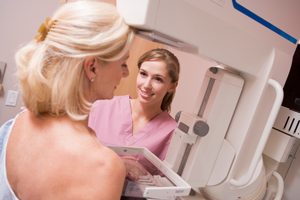
You stand in front of a special x-ray machine. The person who takes
the x-rays (always a woman) places your breasts (one at a time)
between two plastic plates. The plates press your breast and make it
flat. You will feel pressure on your breast for a few seconds. It may
cause you some discomfort, feeling like squeezing or pinching. But,
the flatter your breasts, the better the picture. Most often, two
pictures are taken of each breast - one from the side and one from
above. The whole thing takes only a few minutes.
How is a mammogram done in a woman with breast
implants?
If you have breast implants, be sure to tell your mammography
facility that you have them. You will need an x-ray technician who is
trained in x-raying patients with implants. This is important because
breast implants can hide some breast tissue, which could make if
difficult for the radiologist to see breast cancer when looking at
your mammograms. For this reason, to take a mammogram of a breast with
an implant, the x-ray technician might gently lift the breast tissue
slightly away from the implant.
How often should I get a mammogram?
Women over 40 should get a mammogram every 1 to 2 years. This
guideline was just re-issued by the federal government's U.S.
Preventive Services Task Force. And, it is also the position of the
Secretary of the U.S. Department of Health and Human Services. Women
who have had breast cancer or breast problems, or with a family
history of breast cancer may need to start having mammograms at a
younger age or more often. Talk to your health care provider about how
often you should get a mammogram. Be aware that mammograms don't take
the place of getting breast exams from a health care provider and
examining your own breasts.
If you find a lump or see changes in your breast, talk to your
health care provider right away no matter what your age. Your health
care provider may order a mammogram for you to get a better look at
your breast changes.
Where can I get a mammogram?
Be sure to get a mammogram from a facility certified by the Food
and Drug Administration (FDA). These places must meet high standards
for their x-ray machines and staff. Check out the FDA's web site on
the Internet at:
http://www.fda.gov/cdrh/mammography/certified.html for a list of
FDA-certified mammography facilities. Some of these facilities also
offer digital mammograms.
Your health care provider, local medical clinic, or local or state
health department can tell you where to get no-cost or low-cost
mammograms. Also, call the National Cancer Institute's toll free
number 1-800-422-6237 for information on no-cost or low-cost
mammograms.

How can I get ready for my mammogram?
First, check with the place you are having the mammogram for any
special things you may need to do before you go. Here are some general
guidelines to follow:
-
Make your mammogram appointment for one week after
your period. Your breasts hurt less after your period.
-
Wear a shirt with shorts, pants, or a skirt. That
way you can undress from the waist up and leave your shorts, pants,
or skirt on when you get your mammogram.
-
Don't wear any deodorant, perfume, lotion, or powder
under your arms or on your breasts on the day of your mammogram
appointment. These things can make shadows show up on your
mammogram.
Are there any problems with mammograms?
As with any medical test, mammograms can have limits. These limits
include:
-
Mammograms are only part of a complete breast exam.
If they show abnormalities your health care provider will follow-up
with other tests.
-
False negatives can happen. This means everything
may look normal, but cancer is actually present. False negatives
don't happen often. Younger women are more likely
to have a false
negative mammogram than are older women. This is because the breast
tissue is denser, making cancer harder to spot.
-
False positives can happen. This is when the
mammogram results look like cancer is present, even though it is
not. False positives are more common in younger women than older
women.
This FAQ was adapted from mammography fact sheets from the National
Cancer Institute.
|